
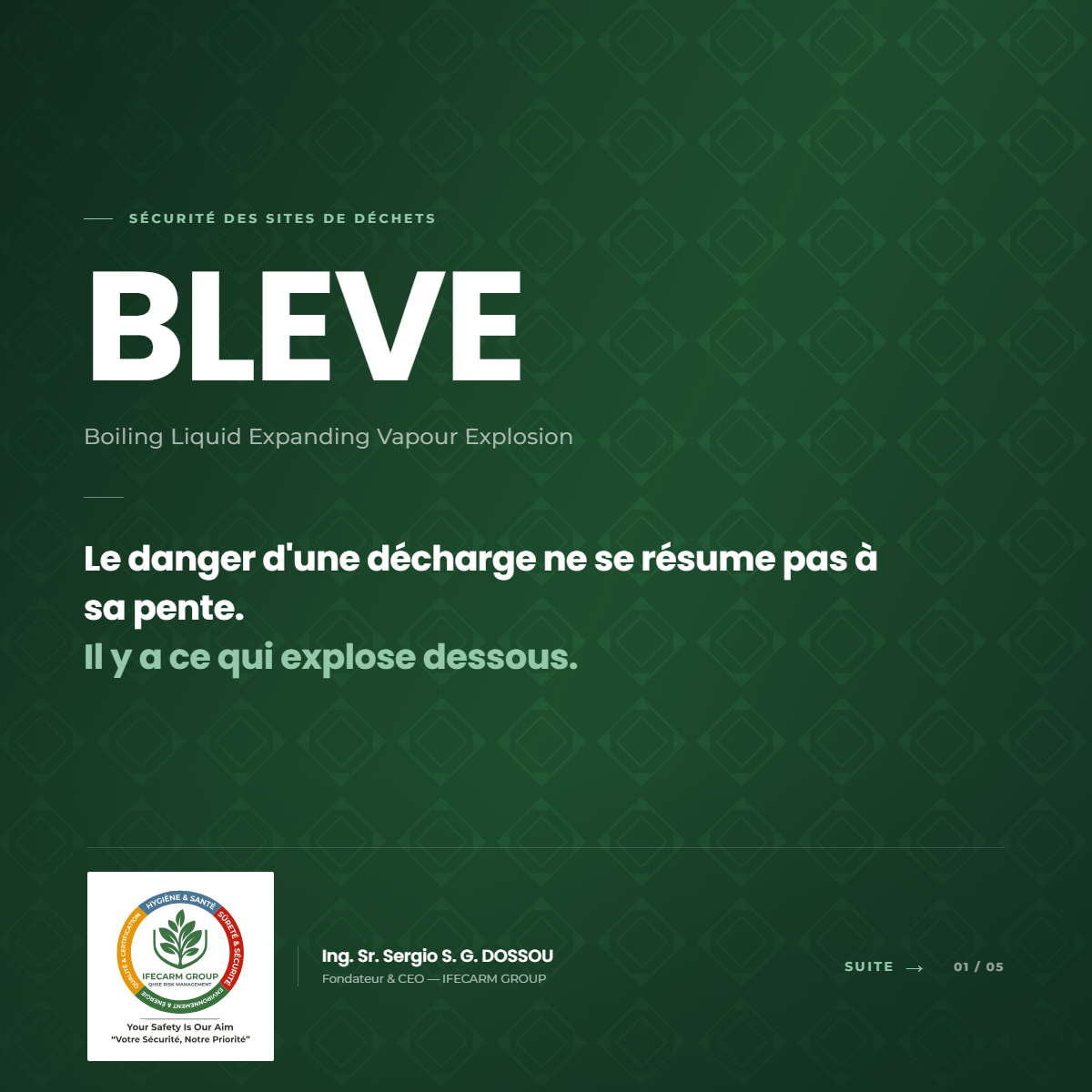
On the night of August 22 to 23, 2026, in Conakry, the Dar-es-Salam waste mass collapsed onto the homes below: 36 people lost their lives. Beyond the landslide itself, IFECARM GROUP highlights a scenario too often overlooked: BLEVE, the explosion of pressurised containers buried inside unsorted waste masses.
Ing. Sr. Sergio S. G. DOSSOU — Founder & CEO — IFECARM GROUP SARL
The same site. The same month of the year. The same collapse. On the night of August 22 to 23, 2026, in Conakry, after heavy rainfall, the Dar-es-Salam waste mass gave way onto the homes below. 36 people lost their lives. A previous collapse had already occurred at this site in August 2017.
These elements are reported as publicly communicated; the precise circumstances of the event remain to be established by the competent authorities. Much is said about the slope. Far less is said about a scenario every responder to a landfill fire dreads: BLEVE.
BLEVE: Boiling Liquid Expanding Vapour Explosion
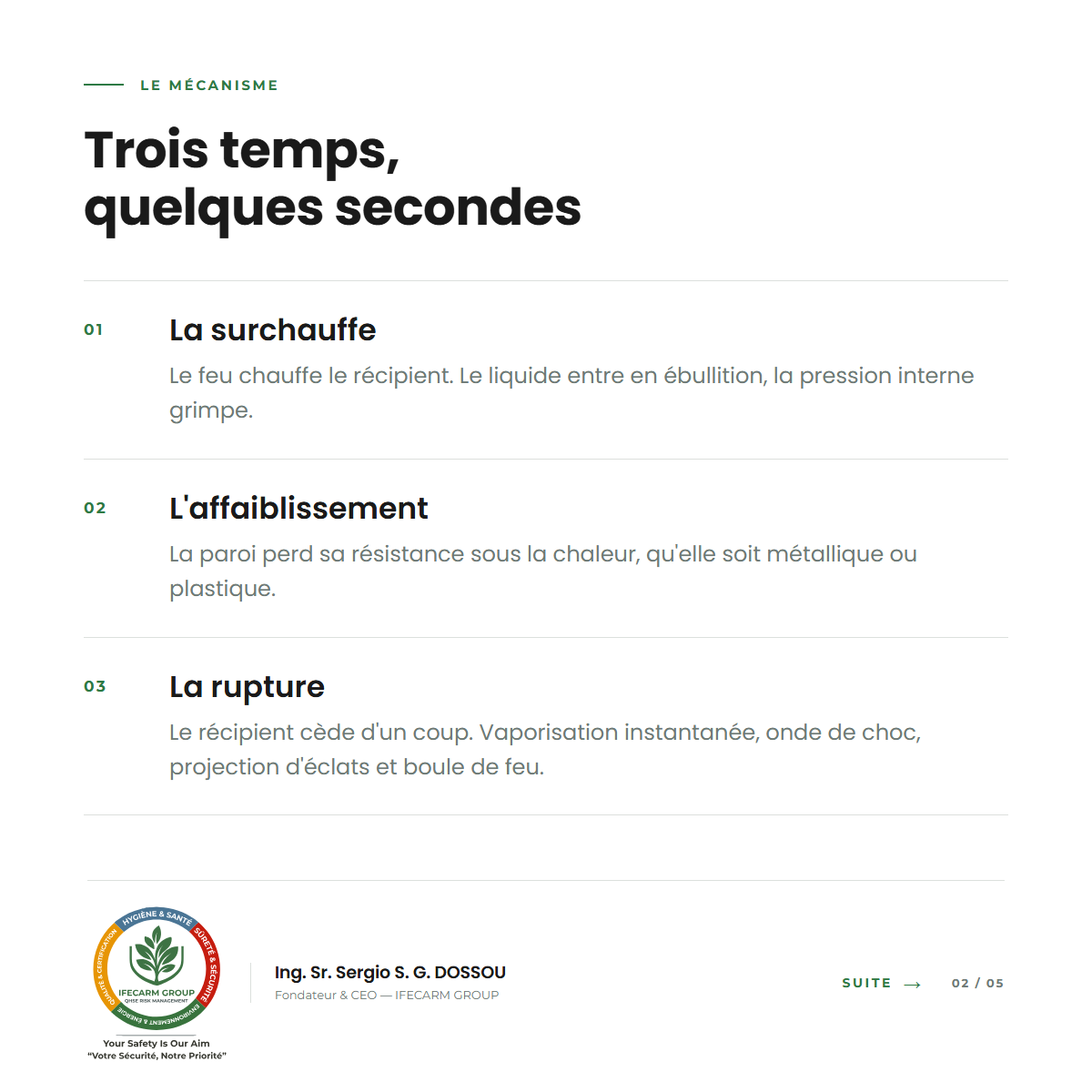
BLEVE is the sudden rupture of a pressurised liquefied gas container heated by a fire. Pressure rises, the wall weakens, then fails all at once: the superheated liquid flashes instantly into vapour. Shockwave, fragments thrown far, fireball.
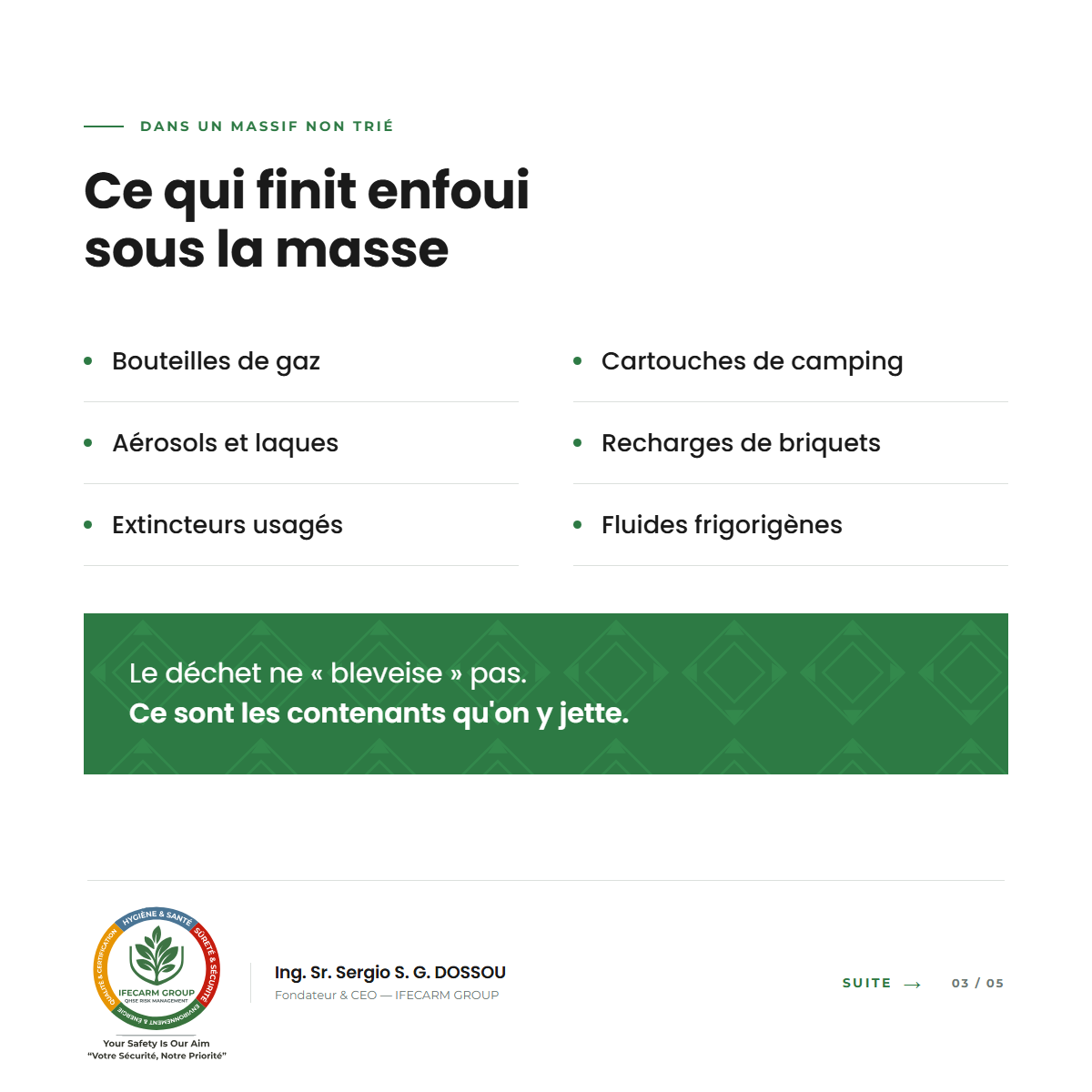
What ends up buried in an unsorted waste mass?
Gas cylinders, camping gas cartridges, aerosols, extinguishers, refrigerant fluids: so many pressurised, hidden containers scattered through the mass. The waste itself does not “BLEVE”. But the accumulation creates the two conditions for the phenomenon: hidden pressurised containers, and a heat source.
A waste mass generates its own heat. Fermentation produces methane, explosive between 5% and 15% in air. Biological degradation is exothermic: deep inside, heat builds up until a smouldering fire ignites. A single crushed lithium battery is enough to trigger it. The fire then heats containers one by one; ruptures follow unpredictably. This is what makes firefighting response so dangerous.
One fire, two timescales
BLEVE strikes fast and close. Smoke strikes slowly and far. A mixed-waste fire releases dioxins, furans and fine particulates for days on end. For a population living at the foot of the site, exposure does not stop once the flames are no longer visible.
What protects
Strict source sorting, which removes pressurised containers and batteries before they reach the mass. Sectorisation of stockpiles. Biogas capture and temperature monitoring. Sorting is not just an environmental policy: it is a safety barrier. The landslide is the visible scenario. It is not the only one.
Our thoughts, and a question for local authorities
To the victims, their families and the people of Gbessia, we extend our sincere thoughts. Municipalities, towns and prefectures: these sites, often inherited and rarely characterised, raise questions that cannot be improvised. IFECARM GROUP supports local authorities in flow characterisation, risk analysis and the development of site-securing plans.
Does your risk analysis cover every scenario, or only the most visible one?