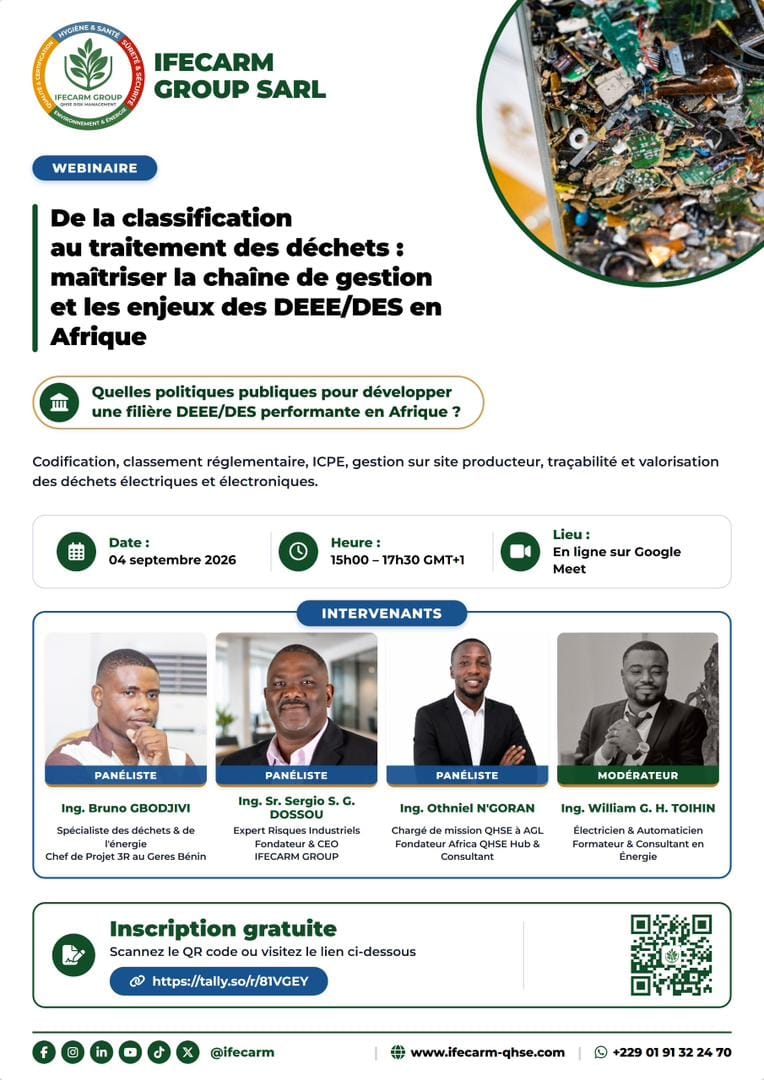
Two and a half hours of discussion between Benin, Côte d’Ivoire and Burkina Faso, around one finding: Africa collects only about 1% of the electrical and electronic waste it generates. Figures, regulatory framework and commitments made.
Sergio S. G. DOSSOU — Founder and CEO, IFECARM GROUP
On 4 September 2026, some sixty QHSE managers, solar companies, NGOs and waste sector players met online, from Benin to Côte d’Ivoire, Burkina Faso, Togo and Senegal. Two and a half hours of discussion on a question the continent can no longer postpone: what becomes of our computers, solar batteries and inverters at end of life?
A soaring waste stream, a sector yet to exist
Bruno GBODJIVI laid out the figures. In Benin, electricity access rose from 31.4% in 2014 to 59% in 2024, according to World Bank data. Over the same period, equipment imports jumped from 5,000 tonnes in 2016 to a projected 35,000 tonnes in 2025 — a sevenfold increase in less than ten years.
Against this growth, treatment capacity remains marginal: according to the Global E-waste Monitor, Africa collects only about 1% of the WEEE it generates. Projections presented for Benin put solar equipment waste at around 47,000 tonnes in 2030, and beyond 1.3 million tonnes by 2045 if nothing changes — mostly batteries.
On top of this sits a large informal market and imports of second-hand equipment, sometimes already at end of life on arrival, repaired for a few months of reprieve before breaking down again.
Benin’s regulatory framework: intent, not yet a manual
Benin is not without law on this. The Constitution guarantees a healthy environment, the framework environmental law has been updated, the public health code and decrees on solid waste apply, and the country has ratified the Basel and Bamako conventions.
A decree of 2 July 2025 now sets out arrangements for managing waste electrical and electronic equipment. But, as Bruno GBODJIVI stressed, it awaits its interministerial implementing orders: as it stands, it is not clear precisely what producers must do, or how. The political will is there; implementation remains to be written.
A direct consequence: without an operational plan, there is no dedicated national fund — funding serves a plan. The avenue mentioned remains the National Fund for the Environment and Climate, which project developers working on structuring the sector could tap.
Extended producer responsibility as the common foundation
The institutional direction is towards an extended producer responsibility (EPR) system, following the model adopted by Senegal, Ghana, Kenya and Rwanda. The principle is polluter-pays: whoever imports, sells or markets equipment becomes responsible for it through to end of life.
All these countries started there: regulation and EPR first, then structural programmes — collection points, dismantling centres, recovery channels.
Classify, trace, and avoid becoming a storage facility
On the operational side, three messages came back insistently. First: waste must be classified before it is treated. The six-digit European nomenclature — family, sub-family, specific waste, with an asterisk marking hazardous status — remains the most rigorous reference in the absence of a national system. WEEE falls under chapter 16 02, batteries and accumulators under 16 06.
Second: traceability rests on a tracking form, from producer to treatment centre, and on an up-to-date register — waste origin, form number, removal date, exact nature, treatment code. Weight is decisive: it is the basis for the EPR levy. The producer must know where their waste ends up, and has every interest in checking the condition of the collecting vehicle: residue from a previous load contaminates their own.
Third, and most concrete for a business: stockpiling waste on site eventually changes its status. You become a storage facility, and therefore the operator of an additional classified activity, with the obligations and insurance problems that follow — not to mention the domino risk between incompatible substances. The advice fits in one sentence: remove waste quickly, and know where it goes.
On treatment, the hierarchy was restated unambiguously: avoid, reduce, reuse, recycle, recover. Landfill is the last resort, and it was explicitly advised against. WEEE contains copper, gold, silver and cobalt: these are resources, not merely a burden.
Risks, seen from the field
Othniel N’GORAN detailed what handling WEEE means in practice: electrocution risk, persistent organic pollutants and heavy metals — lead, mercury — fire and explosion linked to lithium batteries, and soil, air and water pollution. Hence one simple, non-negotiable rule: never mix incompatible components, particularly lithium batteries and screens.
His observation on Côte d’Ivoire holds for the wider region: laws exist, but enforcement and monitoring are lacking, especially among small and medium-sized businesses.
A three-horizon strategy
The session closed on a proposed trajectory. Short term, one to three years: regulatory framework, mapping of waste streams, creation of collection points and public-private partnerships. Medium term, three to five years: consolidation centres and integration of the informal sector. Long term, five to ten years: regional-scale recycling units.
Two warnings drew consensus. First: no single company can hold every link — collection, dismantling, recovery, disposal. Trying to control everything leads to failure; better to specialise in one link and cooperate. Second: texts modelled on European frameworks are not enough. A nomenclature and guidelines designed for African contexts remain to be built.
That is precisely the work IFECARM GROUP is opening in the wake of this webinar: gathering participants’ feedback, formulating proposals to submit to authorities across the region, and working on digital traceability solutions.
The working documents are available
The materials discussed during the session — executive summary, waste nomenclature, tracking forms — are gathered in a document kit available from our resources area. One useful clarification: these frameworks come from French and European law. They are provided as working methods and adaptable templates, not as the law applicable in your country.