
Two and a half hours to unpack the sixth edition of ISO 9001: 46 of 65 requirements unchanged, 7 key changes, and a 9-step transition roadmap running to September 2029.
Sergio S. G. DOSSOU — Founder and CEO, IFECARM GROUP
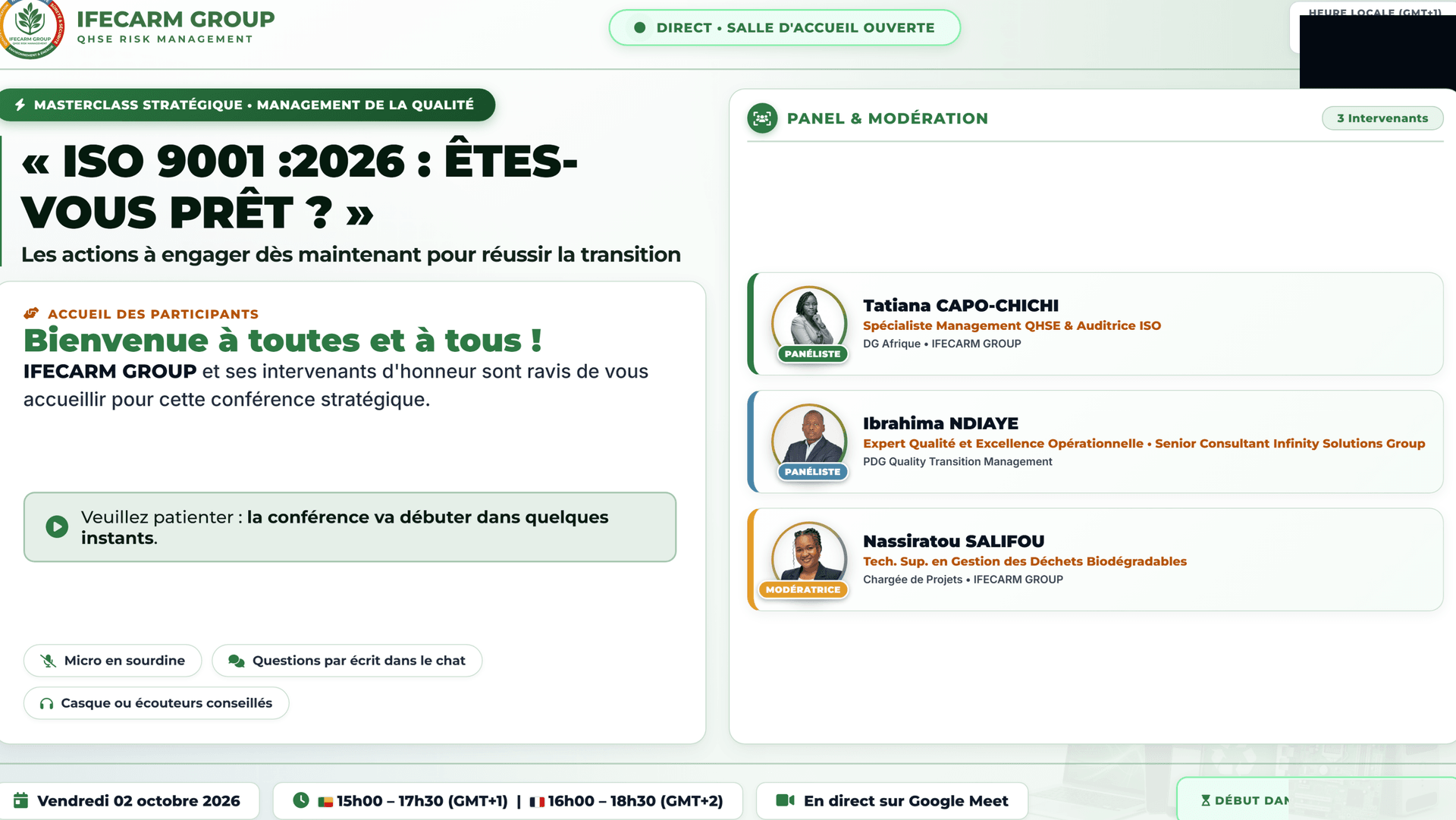
On 2 October 2026, IFECARM GROUP brought together executives and quality managers for two and a half hours around a single topic: the sixth edition of the ISO 9001 standard, published on 16 September 2026. Moderated by Nassiratou SALIFOU, sustainable development project officer at IFECARM GROUP, the session was organised in two parts — what changes and what stays, then the roadmap for a successful transition.
The speakers
Two experts took turns to unpack the 2026 revision and build the transition roadmap.

Tatiana CAPO-CHICHI
QHSE Consultant, Lead Auditor ISO 9001/14001/45001
A QHSE management, audit and management systems consultant with 22 years of experience, a certified Lead Auditor and trainer for ISO 9001, ISO 14001 and ISO 45001. Her clients have included Bouygues Bénin, OFMAS International, ORYX Bénin, LONAB and the ERANOVE Group. She presented the first part, “what’s changing, what stays”.

Ibrahima NDIAYE
CEO, Transition Quality Management — Senior Partner, Infinity Solutions Group
A transition management consultant based in Toulouse. He has worked at AIRBUS, TQM, FORVIA INTERIORS and YAZAKI EUROPE, with expertise in quality turnaround, P&L governance, defect reduction and digital strategy deployment across more than 60 plants. He led the second part, on the transition roadmap.
Partners
Partners of this webinar. Infinity Solutions Group and Transition Quality Management support organisations through operational transformation, represented by Ibrahima NDIAYE, Senior Partner and CEO, who presented the transition roadmap on 2 October.
A revision that refines, not overhauls
Tatiana CAPO-CHICHI first set out the numbers: of the 65 requirements in clauses 4 to 10, 46 remain unchanged, 16 are revised, 2 are new and 1 is renumbered. The 2026 revision builds on the continuity of the 2015 quality system, which she described as a “starting capital”: what works — useful mapping, effective procedures, relevant indicators — is kept; what doesn’t — ineffective practices, duplication, poorly substantiated decisions — is assessed and corrected, drawing on internal audits, complaints and management reviews.
The 7 changes to remember
Beyond the figures, seven changes shape the new edition.
- Leadership and quality culture: management must take ownership, make trade-offs and allocate resources; managers translate and sustain the processes; teams understand, contribute and raise issues. A quality culture is recognised when a problem is reported without waiting for an audit, decisions rest on facts, and errors are treated as learning opportunities.
- Risk and opportunity, now distinct: risk is an undesirable effect to control or reduce, opportunity a potential beneficial outcome to pursue. An example given from construction: a supply delay is addressed with an alternative supplier or stock (risk), while building a local supplier network is a genuine opportunity.
- Strategy: from policy to value creation, through a chain running from vision to objectives, to processes, to indicators, and then to the value produced — customer loyalty, cost control, trust.
- Adaptation and continuity: resilience (anticipate, adapt, learn), digital (data, traceability, ERP and management tools for faster decisions), innovation (commercial, organisational, technological), and a customer promise that is kept.
- Ethical behaviour: accountability, information integrity, transparency, honouring commitments, managerial consistency — leaders set the example — and learning from mistakes.
- New postures for quality managers: less isolated paperwork and signature-chasing, more analysis, challenge, facilitation and data-driven steering; process owners improve based on results, risks and opportunities, and genuinely useful indicators.
- The trap to avoid: starting from new documents and forms leads to administrative overload; the right approach starts from diagnosis, then prioritises and transforms.
In detail, clause 5.1.1 moves from a leadership commitment to an explicit requirement for demonstrable quality culture and ethical behaviour; clause 6.1 now separates risks and opportunities, each to be determined, analysed and evaluated; climate (clauses 4.1-4.2) is durably integrated into context analysis, beyond the simple 2024 amendment; and clause 6.3 on managing change gains three points: communication, effectiveness monitoring and review of results.
What audit findings show
Tatiana CAPO-CHICHI listed the most frequent minor findings raised in ISO 9001:2015 audits: management review treated as a mere formality (clause 9.3), the internal audit programme not followed (9.2), calibration gaps (7.1.5), missing competence records (7.2), insufficient document control — the single most frequent finding (7.5) — and complaints left without corrective action (10.2). A finding becomes major when minor findings pile up on the same clause, when an element of the system is missing or has collapsed, or when a root cause is never addressed despite recurring; an open major finding blocks certification.
The official transition timeline
Three dates mark the transition: 16 September 2026, publication of ISO 9001:2026; 31 March 2028, the date from which accredited bodies can issue new certifications against this edition; and 30 September 2029, the deadline for organisations already certified under the 2015 edition. Three routes are possible: a surveillance audit, a renewal audit, or a dedicated transition audit.
The session closed with five questions worth asking in an African context: what do our customers really expect? Which suppliers could weaken our commitments? Which skills are critical? What data do we need to decide? And what happens if a critical resource runs short?
The transition roadmap, in 9 steps
Ibrahima NDIAYE then took over with a central message: the transition is not a documentation update, but a structured approach to strengthening efficiency, ownership of the system and results. Three success factors determine whether it succeeds: management support, which must make swift trade-offs and allocate resources; co-construction, which directly involves operational managers in revising processes; and pragmatism, which aims for operational efficiency rather than mere administrative compliance.
He proposes a three-phase, nine-step approach spread over nine months.
- Prepare (months 1-3): a gap analysis between 2015 and 2026 with formal management commitment (step 1, “understanding”); a sponsor appointed for each major change (step 2, “adoption”); an action plan for each key change — 5.1.1, 6.1, 4.1-4.2, 6.3 (step 3, “vision”).
- Mobilise (months 4-6): rolling out communication and tracking its effectiveness, per requirement 6.3 (step 4); training process owners and auditors to separate risks and opportunities under clause 6.1 (step 5); a pilot project on one process to secure quick wins and showcase the behaviours expected under 5.1.1 (step 6).
- Embed (months 7-9): consolidation through 2026 internal audits extended to all processes (step 7); embedding quality and ethical culture into behaviours, through to the transition audit (step 8); celebrating results and sharing lessons learned (step 9).
The obstacles he listed are ones any quality manager will recognise: resistance to change — “we’ve always done it this way” —, a perceived lack of time or resources, responsibility pushed elsewhere — “that’s not my role” —, and a feeling of not being informed or heard. Building competence, whether through self-training or certified experts, rests on six pillars — strategy, performance, processes, Lean Six Sigma-style continuous improvement, organisation, and human capital and leadership — each spanning four levels: discover, practise, steer, deploy.
The replay and the deck are available
The full discussion is available as a replay below. The complete deck presented during the session — 41 slides — is gathered in a document kit available from our resources area.
IFECARM GROUP closed the session by presenting its support offer: gap diagnosis and analysis, ISO 9001:2026 transition with a realistic, manageable roadmap, ISO consulting and support on processes, documentation and indicators, internal audits and mock audits, training and skills development, and performance and continuous improvement. A further session has already been announced for November 2026.
Related articles
Also worth reading on the IFECARM GROUP QHSE blog.